The Grand Canal by gondola: what you actually float past
The big water is only part of the ride. Half an hour buys you a crossing, a curve past a dozen palace fronts, and then a turn into canals narrow enough to touch both walls.
By Marco Zanetti, Venice gondola ride specialist & canal experience guide
Short answer
No gondola runs the whole Grand Canal. Most rides cross it, spend ten to fifteen minutes on the big water, then turn into the side canals where the wash dies down. The boarding point decides your stretch: Campo San Moise and Giardinetti feed the San Marco end, Riva del Carbon the Rialto curve, Piazzale Roma the quiet upper canals.
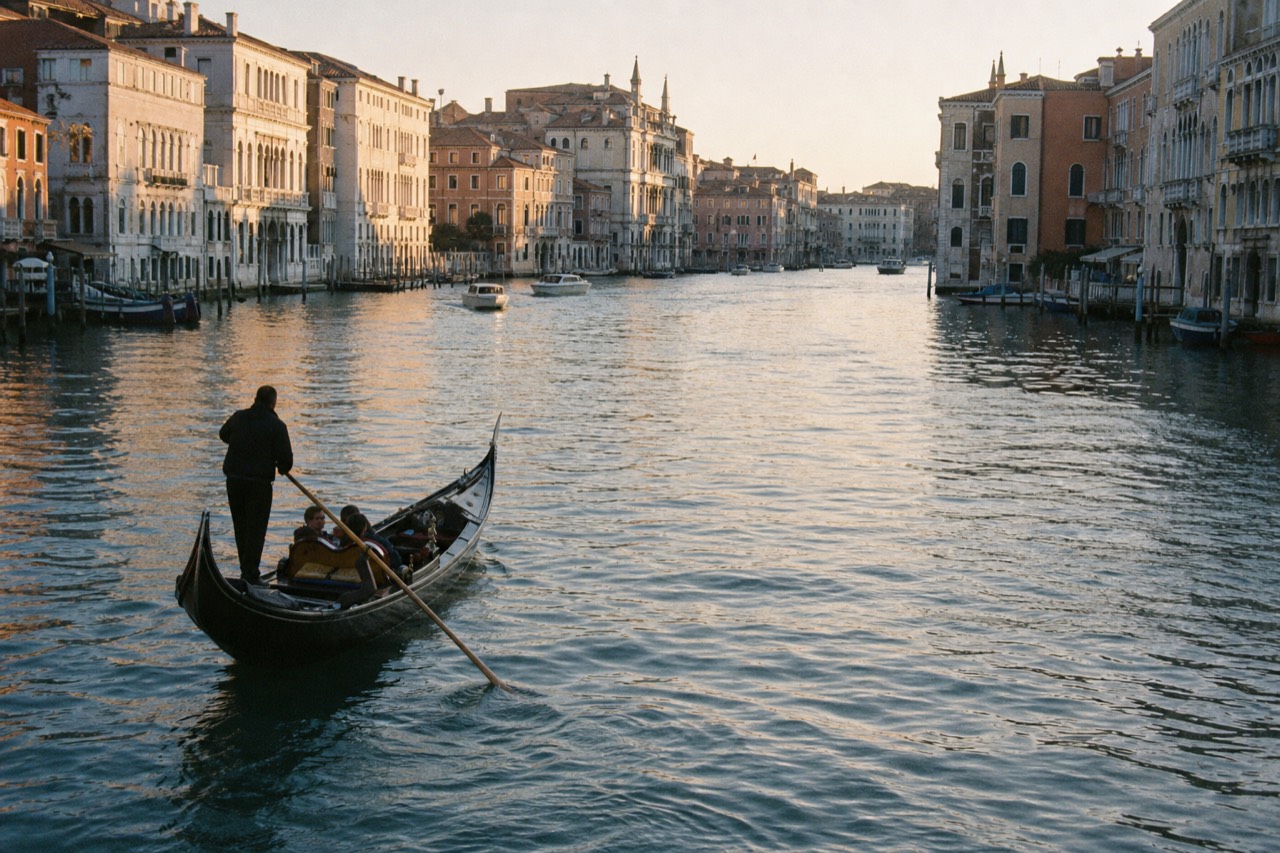
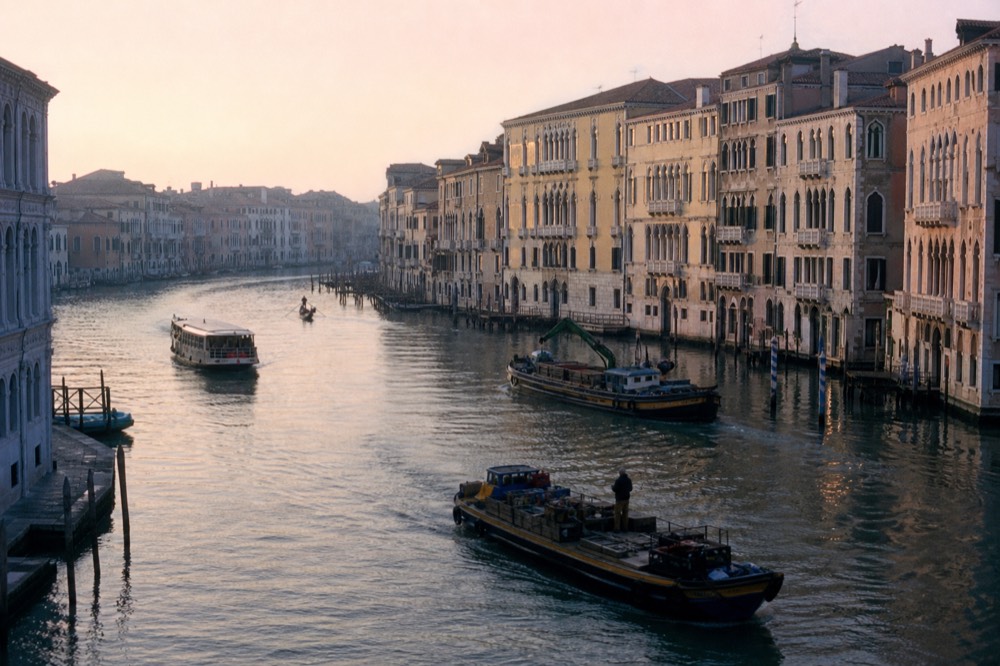
Stand on the Rialto bridge for ten minutes and you will see the whole problem. Waterbuses shoulder past each other in the middle of the channel, delivery barges cut across the diagonal, a taxi opens up and throws a metre of wash into the palace steps, and somewhere underneath all of it a gondolier is standing at the stern with one oar, holding a line. That is the Grand Canal on a normal Tuesday. It is not a scenic lane. It is the main road of a city that has no roads, and a gondola crosses it the way a pedestrian crosses a boulevard: quickly, deliberately, and with an eye on the traffic.
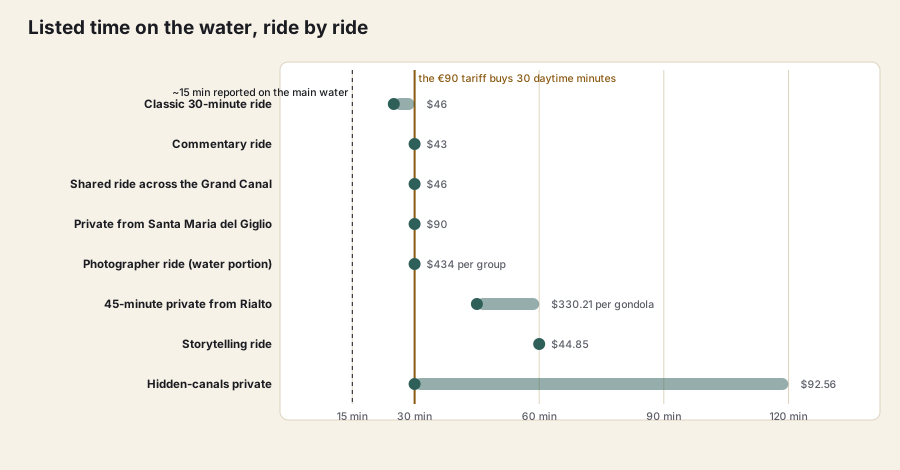
Which is why almost nobody gets the ride they imagined. Travellers picture a slow hour drifting the full S of the canal from the station down to the basin. What the boats actually do is shorter, tighter, and in most cases better. Our reading of current traveller reports puts real time on the main water at somewhere around fifteen minutes of a thirty-minute ride, with the rest spent in the cuts behind it. The rest of this page is about what falls into those fifteen minutes, what falls into the other fifteen, and how much of it your boarding point decides for you.
What shape is the Grand Canal, and where does a gondola fit on it?
The Grand Canal is a reverse S running from Piazzale Roma and the railway station at the top down to the open basin at San Marco. Four bridges cross it. A gondola ride touches one arc of that S, usually between the Rialto curve and the basin, and spends the balance of its half hour in the side canals feeding off it.
Think of the canal as three arcs rather than one line. The upper arc, from the Constitution bridge past the station and down towards the fish market, is workaday water: freight, ferries, service boats, wide banks. The middle arc bends hard at Ca' Foscari, the point Venetians call the volta, the turn, and that bend is the one every painter has used because both banks stack up in the same frame. The lower arc runs from the Accademia bridge down past the Salute and out into the Bacino di San Marco, and it is the one with the postcard on it.
Gondolas do not treat these arcs equally. The lower arc is short, deep in tourist traffic, and ringed by the busiest boarding points in the city, so the highest concentration of rides works that end. The middle arc is where private hires with longer bookings tend to go, because a forty-five minute boat has time to reach the bend and come back. The upper arc mostly belongs to residents, ferries and the one private ride on this site that starts up there deliberately.
Arc of the canal
Runs from
Character on the water
Gondola presence
Upper
Constitution bridge and the station down to the market
Freight, ferries, service traffic, wider banks
Low, mostly private hires starting at Piazzale Roma
Middle
Rialto through the great bend at Ca' Foscari
Densest palace frontage, heavy waterbus stops
Moderate, longer private bookings reach it
Lower
Accademia bridge to the Salute and the basin
Postcard frontage, worst wash, most day traffic
Highest, most stations sit within a few minutes of it
One correction worth making early, because it costs people their expectations. The Bridge of Sighs does not cross the Grand Canal. It spans the narrow Rio di Palazzo behind the Doge's Palace, and passing under it is a side-canal manoeuvre, not a main-water one. Several rides from the San Marco stations do go there. None of them do it while on the Grand Canal, and if a route promises both it is promising two different waters.
Which stretch of the Grand Canal does each ride cover?
Your boarding point decides your stretch, not the listing text. Campo San Moise and San Marco Giardinetti put you on the lower arc within a minute or two of casting off. Riva del Carbon and Caffe Rialto start you in the busiest, most photographed water in the city. Piazzale Roma starts you at the top of the S, away from the crowd entirely.
The tours sold for this stretch cluster tightly, and once you plot them by where they leave from, the differences stop being about the product description and start being about geography. Two rides at the same price can show you completely different canals.
Ride
Boards at
First water you reach
Listed length
Grand Canal ride with commentary
Campo San Moise area
Lower arc, San Marco end
30 minutes
Shared ride across the Grand Canal
Alilaguna office, San Marco Giardinetti
Basin, then lower arc
30 minutes
Classic 30-minute ride
San Marco Giardinetti, Riva degli Schiavoni
Basin waterfront, then lower arc
25 to 30 minutes
Ride with storytelling and gallery
Near St. Mark's Square
Lower arc plus back canals
1 hour
Private ride from the Giglio
Santa Maria del Giglio, by the Gritti
Mid canal, both directions available
About 30 minutes
Private 45-minute from Rialto
Riva del Carbon, Rialto
The Rialto curve itself
45 to 60 minutes
Private off the beaten path
Piazzale Roma station
Upper arc and quiet cuts
30 minutes to 2 hours
Ride with professional photographer
Caffe Rialto
The Rialto curve
1 hour, 30 on the water
Read that table as a map and the choices resolve fast. If the Grand Canal itself is what you came for, the Rialto departures put you in it from the first stroke, and the private forty-five minute boat from Riva del Carbon is the only listing here that buys enough time to work the curve properly rather than crossing it. If what you want is the classic San Marco set piece, the commentary ride out of Campo San Moise is the one most people take, at $43 a seat with 25,858 reviews behind it at 4.2. And if the main water is precisely what you are trying to escape, the private boat from Piazzale Roma is the highest-rated ride in the lineup at 4.3 across 1,099 reviews, and it barely touches the tourist arc at all.
There is a broader point buried in that spread. The rides that spend the most time on the Grand Canal are not the best-reviewed ones. The two highest ratings in the whole set, 4.3 for the Piazzale Roma private boat and 4.9 for the photographer's hour, both belong to products that treat the main water as a passage rather than a destination. When you are weighing which stretch matters to you, the ranked comparison of all thirteen rides sets the ratings side by side with the routes.
What do you pass between San Marco and the Rialto?
On the lower and middle arcs you pass the Salute's dome and the old customs point at the canal mouth, the low white Venier palace holding the Guggenheim collection, the leaning marble front of Palazzo Dario, the Accademia bridge in wood, and then Ca' Rezzonico, Ca' Foscari and Palazzo Grassi as the water bends towards the Rialto.
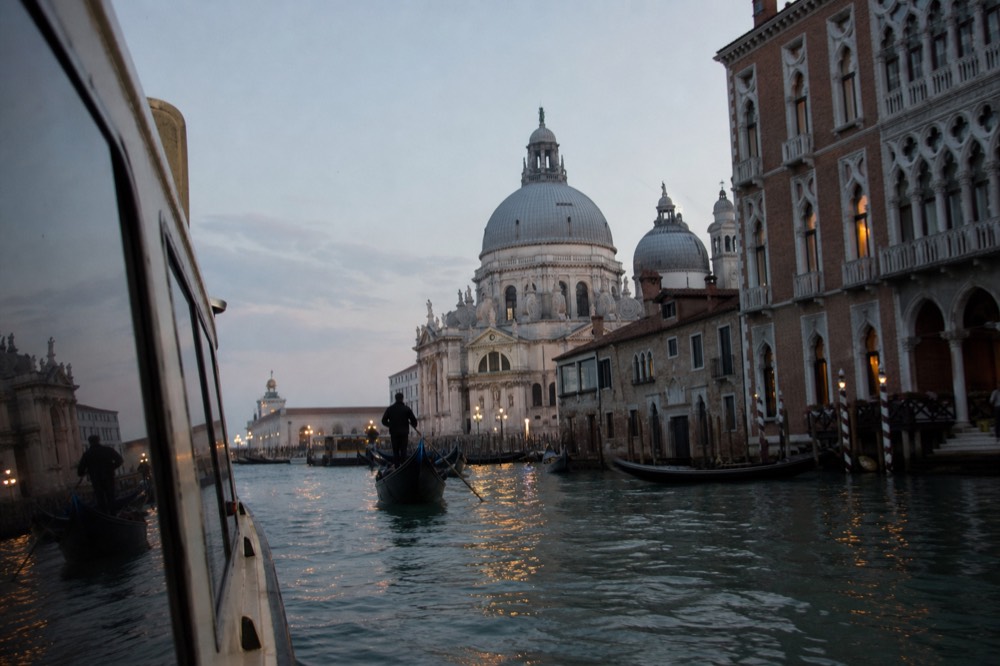
The lower arc is dense. Coming out of the basin you meet the Punta della Dogana first, the blunt triangular point where the customs house used to weigh what came in, and immediately behind it the church of Santa Maria della Salute, built as the city's thanks for the end of the plague of 1630 and 1631. That dome is the single most recognised silhouette on the water, and it reads best from a low boat rather than from the bridges, which is the one genuine advantage a gondola has over a waterbus.
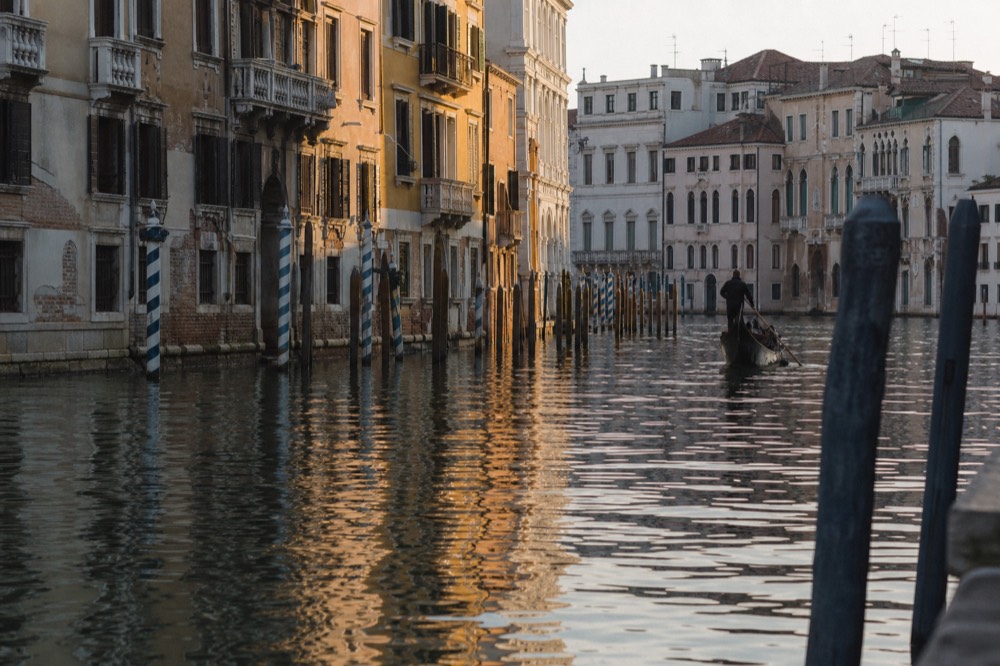
Push up the canal and the palace fronts start doing the work. Palazzo Venier dei Leoni never got past its ground floor, which is why it sits oddly low and white among taller neighbours and why the Guggenheim collection fits inside it. Palazzo Dario leans, visibly, its face studded with marble roundels. Then the wooden deck of the Accademia bridge passes overhead and the canal opens into its widest, calmest section before the great bend.
Landmark
Side of the canal
What to look for from the water
Punta della Dogana
Dorsoduro, at the canal mouth
The blunt stone point where the canal meets the basin
Santa Maria della Salute
Dorsoduro
The great dome and the wide flight of steps at the water
Palazzo Venier dei Leoni
Dorsoduro
A single low white storey among tall neighbours, sculpture on the terrace
Palazzo Dario
Dorsoduro
A visible lean and a facade set with coloured marble discs
Accademia bridge
Crosses to San Marco
The only wooden deck of the four crossings
Ca' Rezzonico
Dorsoduro
Broad baroque front, heavy water-level arches
Ca' Foscari
Dorsoduro, on the bend
The palace on the turn, best two-bank view in the city
Palazzo Grassi
San Marco
Flat classical front, unusually plain for this water
Riva del Carbon
San Marco, below the Rialto
The open quay where private boats pick up
The bend at Ca' Foscari deserves its own note. It is the point where the canal turns hardest, and because both banks curve into the same field of view, it produces the only stretch where a photograph taken from a boat contains a genuine wall of palaces rather than one facade at a time. Rides that reach it are the ones that bought time. Half-hour products leaving from the San Marco end mostly do not get there and back.
Above the Rialto the character changes again. The market side of the canal is a working frontage, the palaces thin out, and the water carries more freight than sightseeing. Very few gondola products go up there on purpose. The one that does starts at the top and comes down.
Which bridges does a gondola pass under?
Four bridges cross the Grand Canal. From the top: the Constitution bridge at Piazzale Roma, the Scalzi by the railway station, the Rialto, and the Accademia. A typical thirty-minute ride from the San Marco stations passes under one of them at most, usually the Accademia. Passing under the Rialto takes a departure from the Rialto itself or a longer booking.
This is the single most common gap between expectation and delivery on this stretch of water. People assume that any gondola on the Grand Canal goes under the Rialto. Geometry says otherwise. From Campo San Moise or the Royal Gardens, the Rialto is a long way up a busy channel, and a half-hour round trip cannot reach it without cutting everything else out.
Bridge
Where it sits
Built of
Which rides realistically pass it
Constitution
At Piazzale Roma, top of the canal
Glass and steel, the newest of the four
The private boat starting at Piazzale Roma
Scalzi
By the railway station
Stone, single high arch
Upper-arc routes only, rare on tour products
Rialto
Mid canal, the commercial heart
Stone, finished at the end of the 1500s
Rialto departures and longer private bookings
Accademia
Between the Salute and the bend
Timber deck on steel
Most lower-arc rides that push north
There is a fifth crossing nobody counts, and it is the cheapest gondola in Venice. The traghetti are working gondolas that ferry people straight across the Grand Canal at a handful of points where no bridge exists, and the crossing costs about two euros. You stand rather than sit, it lasts a couple of minutes, and it is not a tour in any sense. But it is a real gondola on the real canal for the price of a coffee, which makes it the honest answer for anyone who wants the hull under them without the half-hour fare. We put it next to the other options in how the three boats differ.
Longer bookings do not buy proportionally more Grand Canal; they buy more side canal.
Why do gondolas leave the Grand Canal for the side canals?
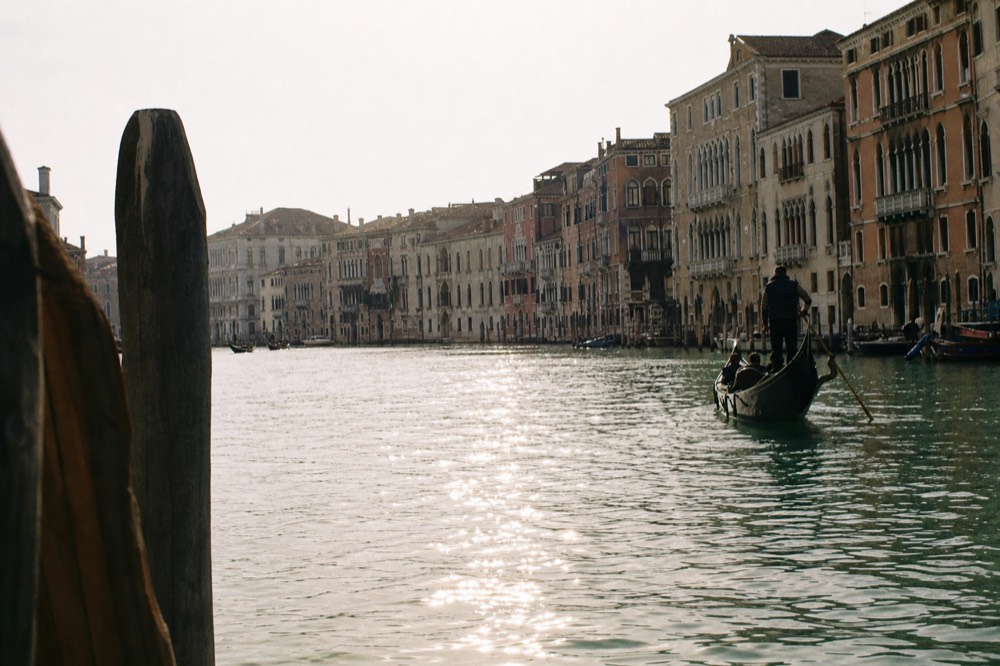
Because the main water is rough and loud. The most consistent complaint in current traveller reports is not the price, it is wash and engine noise from waterbuses and taxis on the busy stretches. Gondoliers cut into the side canals to get out of it, and the quieter water is where most people say the ride finally works.
A gondola is asymmetric, flat-bottomed and rowed from one side by a standing man with a single oar. That design is beautiful and it is also, on open water crossed by dozens of powered hulls, a lot of work. Chop bounces off stone banks with nothing to absorb it, so the same wave hits you twice. The boat handles it fine. The mood does not.
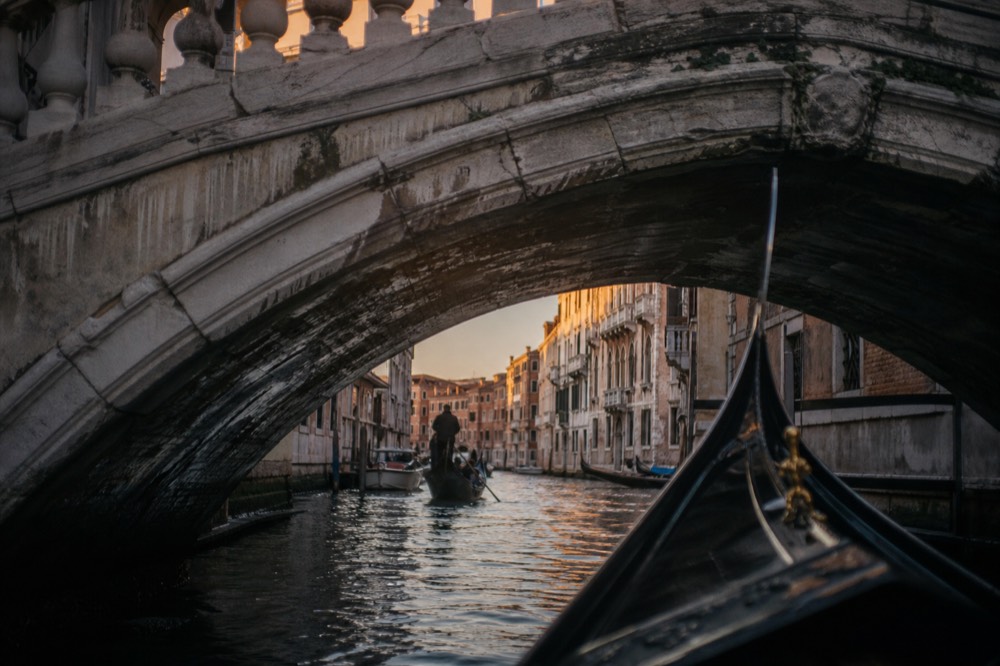
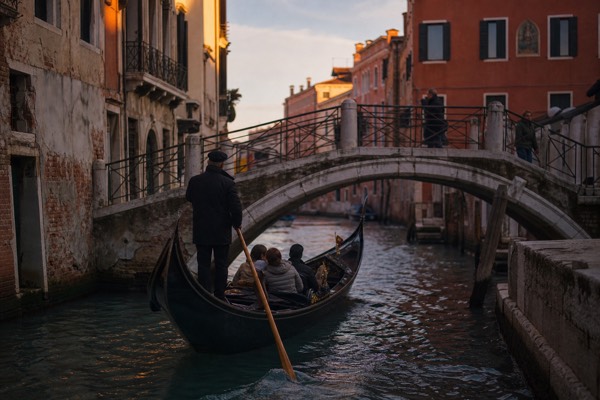
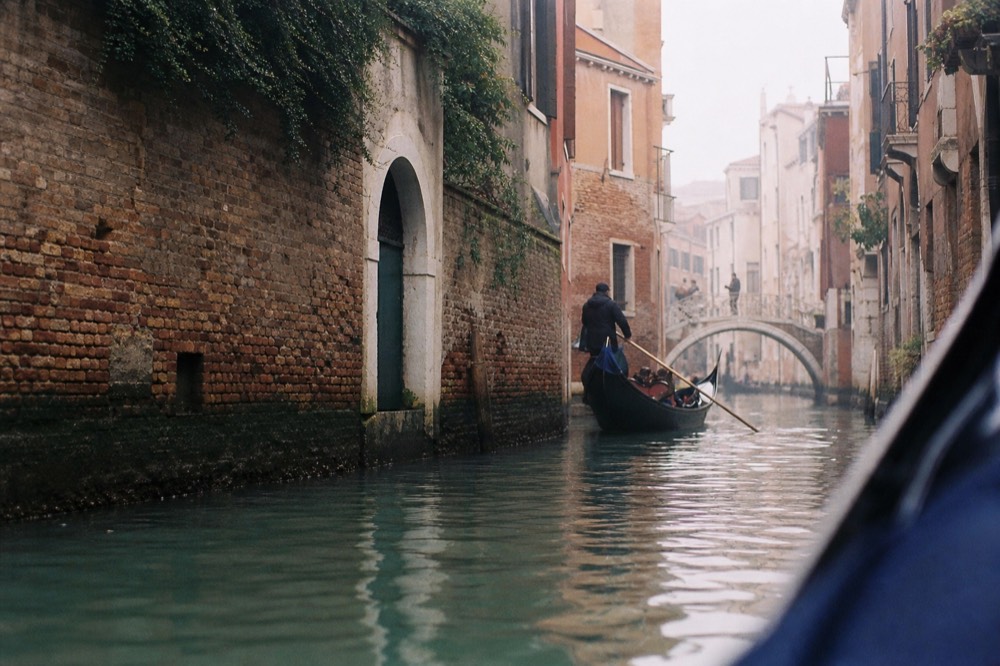
Slip into a side canal and everything changes within a boat length. The walls close to a few metres, the water goes flat, the noise drops to oar splash and the gondolier's warning call at blind corners, and you are suddenly at the eye level of doorways, water gates and washing lines. This is the part of the ride people describe afterwards. It is also, unhelpfully for expectations, the part that photographs least like the brochure.
Grand Canal
Side canals
Water
Choppy, crossed by powered traffic
Flat, wash rare
Noise
Engines, waterbus horns, tourist volume
Oar, echo, occasional voices
Views
Palace facades, domes, bridges
Doorways, water gates, small bridges, laundry
Photography
Wide landmark shots, hard to hold steady
Close, atmospheric, low light
Share of a 30-minute ride
Roughly half by traveller accounts
Roughly half, and rising on private routes
The honest conclusion is that the Grand Canal sells the ride and the side canals deliver it. Routes built around that fact rate better. The Piazzale Roma private boat is explicitly a back-canal product and holds the highest rating of any ride in the lineup, while the cheapest walk-up-style shared product on the busiest San Marco water carries the lowest, 3.2 across 1,089 reviews. Nothing about the boats differs. The water does. If quiet canals are the priority, a private boat with the route to yourselves is the version to look at, and you can check live prices and dates before deciding how long a booking to take.
Forty-five minutes to a full hour, private, from the Rialto end where the Grand Canal is at its busiest and most photogenic. One price covers the whole gondola for up to five, so a full boat costs less per person than most shared seats.
A full hour instead of the usual thirty minutes, with a storyteller setting up the route before you board and a photo gallery of your ride afterwards. The slowest-paced of the shared options, and the one to pick when half an hour feels too short to justify the trip.
Early morning is the calmest water of the day and the shortest queue. Midday in summer is the worst combination: peak boat traffic, peak heat and waits at the central stations that current reports put anywhere from half an hour to over an hour. Golden hour is the best light and the busiest demand. After 19:00 the canal empties and the night tariff starts.
Water conditions on this canal are a traffic problem, not a weather one, for most of the year. Powered traffic builds through the morning, peaks around the middle of the day when day visitors and delivery runs overlap, eases in the late afternoon, and drops sharply after dinner. A gondola on the same stretch feels every bit of that.
Time of day
What the water is like
What the stations are like
Best for
Early morning
Flattest of the day, low traffic
Shortest waits, gondoliers still setting up
Photography, calm, families
Late morning
Building traffic, regular wash
Queues forming at central stations
Acceptable if you cannot start early
Midday
Busiest powered traffic of the day
Longest waits, and in summer the hottest hours
Almost nothing, avoid in heat
Late afternoon
Traffic easing, light softening
Steady, rising towards sunset
Comfortable compromise
Golden hour
Calmer water, best colour
Peak demand, the one reliable pinch point
Light and atmosphere
After 19:00
Quiet, lit facades, minimal wash
Thin crowds, night tariff applies
Quiet and reflections
Summer adds a separate problem that has nothing to do with boats. Italian authorities issued top-level heat alerts covering Venice during 2026, with advice to stay out of direct sun between roughly 11am and 6pm. A gondola has no roof. On a red-alert afternoon the ride you booked for romance becomes forty euros of shade you do not have, and every argument for an early or late slot gets stronger. The month-by-month version of this, including when sunset actually falls, sits in how the light changes after seven.
Can you ask for a particular route along the Grand Canal?
You can ask, and on a private boat you will often get most of what you asked for. No operator guarantees a fixed route, and none of the listings on this site promise one. Gondoliers route around traffic, tide, blocked canals and the queue at popular turns, so the sensible approach is to name one priority rather than a full itinerary.
This is where the site's honesty rules and reality point the same way. A gondola has no timetable and no lane. The gondolier decides in the moment which cuts are passable, where the wash is bad, and whether the turn you want is currently stacked with four other boats. Even the products whose descriptions name landmarks describe a typical route, not a contractual one.
What works is a single clear request made before you cast off, not halfway through. "We would rather have quiet canals than the big water" is a request any gondolier can act on. "The Bridge of Sighs, then the Rialto, then the Salute" is not a route, it is three separate rides. On a shared boat you have no say at all, because the route is set by the operator and the other five passengers.
What you want
Ask for it on
Realistic outcome
Maximum time on the main water
A private hire from Riva del Carbon
Good, the Rialto curve is right there
Quiet back canals, minimal traffic
A private hire from Piazzale Roma
Very good, that is the product's whole design
Passing under the Bridge of Sighs
A San Marco departure, stated up front
Common but never guaranteed
A specific palace or bridge
A booking of 45 minutes or more
Possible if it is near your station
Any route at all on a shared seat
Nothing, the route is fixed
None, and the price reflects that
The commercial logic underneath is simple. The city's regulated tariff, set by the municipal gondola service rules, sells you time, not distance: 90 euros for thirty minutes in the day, 110 for thirty-five after 19:00, per boat rather than per person, up to five passengers. Extensions run 40 euros for each extra twenty minutes during the day and 50 at night. Nothing in that structure buys a route, which is exactly why longer bookings, not louder requests, are what actually change where you go. The arithmetic behind those numbers, and how the booked seats compare, is broken down in what the tariff and the listings actually cost.
Who should skip the Grand Canal route entirely?
Anyone whose main goal is a quiet, atmospheric ride should board somewhere else. The main-water stretch is the loudest, wettest and most crowded part of any gondola route in Venice, and the ratings show it: the products built around back canals score highest, while the busiest San Marco shared product sits at 3.2.
Three groups in particular should think twice. People who are noise-sensitive or prone to seasickness will find the chop between powered boats genuinely unpleasant on a bad afternoon. People travelling with small children often want the twenty minutes of quiet more than the landmark list. And anyone who has already seen the canal from a waterbus, on foot from the bridges, or from a hotel window has arguably had the view, and a back-canal route gives them something they have not had.
The opposite case is just as real. If this is a single day in Venice and the Salute, the palace fronts and the Rialto are the reason you came, then the main water is the point and you should book the departure that starts closest to it. There is no wrong answer here, only a mismatch between what people book and what they wanted. That mismatch is what the reviews are made of.
One practical caution about combinations. The guided combination products, which pair a walk or a museum entry with a ride, put the gondola at the end of a long block of touring. Three and a half hours in, on a hot afternoon, the water stretch lands very differently than it would as a standalone morning ride. They are strong products, and the walk-and-ride combinations include the best-rated one in the lineup at 4.6, but book them knowing the ride is the dessert and not the meal.
The city and its lagoon carry a UNESCO World Heritage listing that covers precisely this water, and the gondoliers' own institution, Ente Gondola, is the body behind the trade you are hiring. Neither fact changes your route. Both are useful when you want to know whose rules you are floating under.
Common questions about the Grand Canal gondola route
Does a gondola ride cover the whole Grand Canal?
No. The canal is a long reverse S from Piazzale Roma down to the basin at San Marco, and no standard ride runs its full length. A thirty-minute ride covers one arc and spends much of its time in the side canals. Even a two-hour private booking from the top of the canal is built around quiet cuts rather than a full run down the main water.
Will my gondola go under the Rialto bridge?
Only if you board near it or book a longer ride. From the San Marco stations the Rialto is too far up a busy channel for a half-hour round trip. The private forty-five to sixty minute hire from Riva del Carbon starts at the Rialto curve itself, which is the reliable way to get that shot.
Why is the Grand Canal so choppy during a ride?
It is the city's main traffic artery, so waterbuses, taxis and delivery barges cross it constantly and their wash bounces off stone banks with nothing to absorb it. Current traveller reports name that noise and movement as the most common complaint about the main-water stretch. Gondoliers turn into the side canals partly to escape it.
Can I ask the gondolier to take a specific route?
On a private boat you can ask, and one clear priority stated before you cast off usually gets honoured. No operator guarantees a route, because traffic, tide and blocked canals decide what is passable on the day. On a shared seat the route is fixed by the operator and you have no say in it.
Is there a cheap way to ride a gondola on the Grand Canal?
Yes, the traghetto. These are working gondolas that ferry passengers straight across the canal where there is no bridge, at roughly two euros a crossing. You stand, it takes a couple of minutes, and it is transport rather than a tour, but it is a genuine gondola on the real canal.
Which departure gives the most time on the main canal?
The private forty-five to sixty minute hire from Riva del Carbon, because it starts in the Rialto curve and has the duration to work it rather than cross it. The photographer's hour from Caffe Rialto starts in the same water. Every San Marco departure has to spend part of its half hour reaching the interesting stretch.
The Grand Canal crossing most people actually book
Thirty minutes across the main water and into the side canals, with an audio story in eleven languages so you know which palace front you are passing. It carries 25,858 reviews at 4.2, the deepest review base of any gondola ride in the city.